🎧 Listen to the Podcast Version
Prefer listening over reading? This is a podcast-style discussion generated from the article — not a text-to-speech narration.
⏱ ~ 22 min listen • Best for multitasking
TL;DR:
The “10x Freelancer” promises speed at low cost. The reality is different. Three risks destroy this model:
- Bus Factor of 1 – Your project dies if they leave
- 42% Technical Debt Tax – Half your budget goes to fixing their shortcuts
- Security Black Holes – Compliance failures that kill enterprise deals
The fix is Managed Engineering Pods. These are cohesive teams with shared knowledge and delivery management. Total cost of ownership favors pods by 50% when you account for rework and management overhead.
The Roadmap Trap: Speed Without Direction
Your company has vision. You have capital. You lack engineering capacity. This is the “Roadmap Trap.” It kills velocity and hands market share to competitors.
The pressure to ship faster creates desperate decisions. Founders look for quick fixes to engineering bottlenecks. The market offers an attractive solution: the 10x Freelancer. These lone wolf developers promise immediate results at a fraction of traditional costs.
But speed is not velocity. Speed measures raw output. Velocity measures progress toward strategic goals. Freelancers optimize for speed. They sacrifice long-term velocity. A car going 100 mph in the wrong direction has high speed but negative velocity. Freelancers often create this exact scenario.
This creates “10x Risk” through three vectors: Bus Factor of 1, Happy Path technical debt, and security black boxes. Each one alone can kill a project. Together they create existential threats.
Why Freelancers Look Attractive
The appeal of freelancers is rational. They solve immediate pain points.
- Speed to Code: Traditional hiring takes months. You screen hundreds of resumes. You conduct five interview rounds. The average time to fill a senior engineer role exceeds 60 days. Freelancers bypass this entirely. They start coding tomorrow.
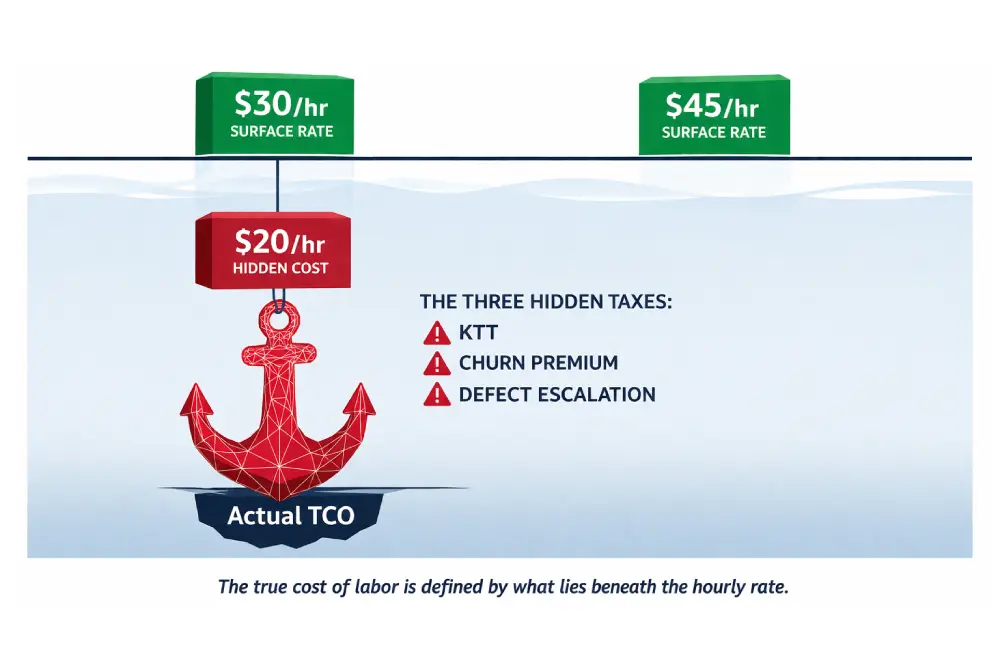
- Lower Sticker Price: A senior freelancer charges $100-150 per hour. A full-time senior engineer costs $180k in salary plus 30% for benefits and taxes. That is $234k annually or $112 per hour. The freelancer has no benefits, equity, or office space. The hourly rate looks competitive.
- Operational Flexibility: Markets change fast. Freelancers let you pivot without baggage. You need a feature built. You hire a freelancer. The feature ships. The freelancer leaves. No severance. No cultural debt.
These benefits are real. But the surface-level benefits hide catastrophic long-term costs.
The Bus Factor Problem: Mathematical Certainty of Failure
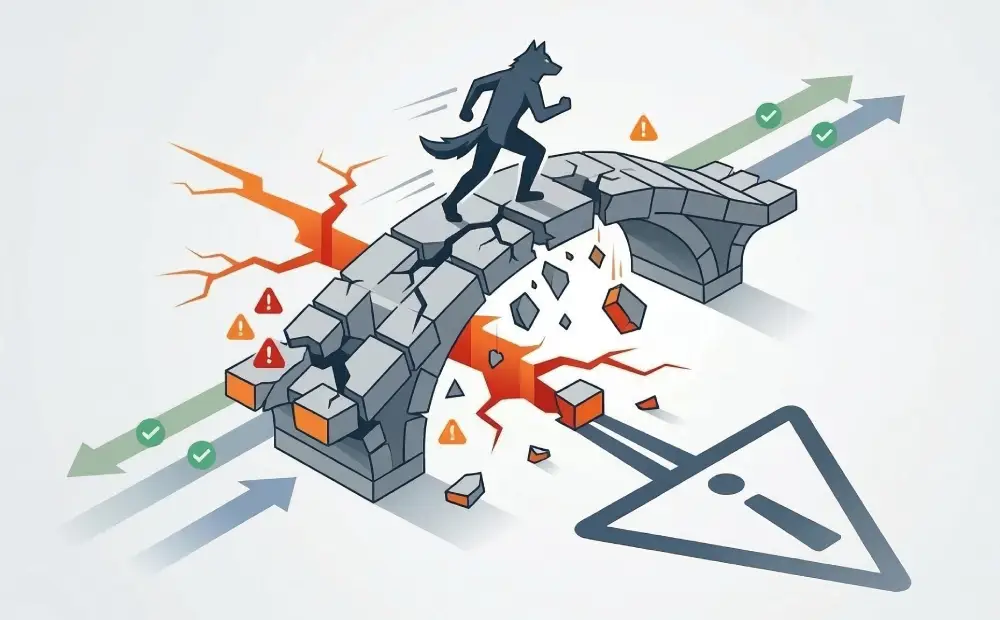
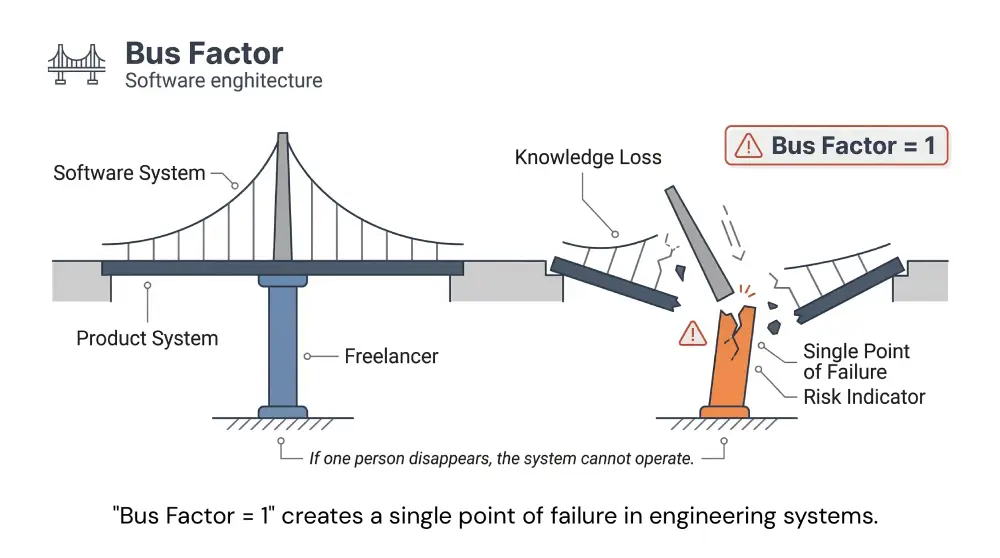
The Bus Factor measures project fragility. How many people must disappear before your project dies? With a freelancer, your Bus Factor is 1.
The Tacit Knowledge Trap
Software is not just code files. It is crystallized decision-making. Every line represents choices about business logic, data structures, and system architecture. A freelancer building your checkout system makes 1000 micro-decisions. Which payment gateway to use. How to handle failed transactions. Where to log errors. How to retry network failures.
Most of these decisions never get documented. They exist only in the freelancer’s memory. This is tacit knowledge. It cannot be transferred through code alone. When you read code written by someone else, you see what it does. You rarely understand why it does it that way. You miss the context and edge cases.
When that person leaves, you lose the ability to maintain your own product. You cannot debug issues. You cannot add features. You cannot deploy safely.
The Hostage Situation
Single-person dependency creates power imbalance. The freelancer realizes they are irreplaceable. The leverage shifts completely.
The freelancer starts raising rates. You have no choice but to pay. The cost to replace them is rewriting everything from scratch. The freelancer misses deadlines. You cannot push back hard. If they quit, your product dies. The freelancer refuses to document their work. They say it slows them down. The dependency deepens with every sprint.
Your CTO cannot give honest feedback. Your timeline depends on one person’s goodwill. This is not a partnership. It is a hostage situation.
The Ghosting Reality
72% of freelance engagements experience ghosting. The freelancer stops responding to emails. Work halts completely. This is not malice. It is rational economics. Freelancers are micro-businesses optimizing for their own revenue.
A better-paying client emerges. Your freelancer switches. A difficult bug frustrates them. They move to easier work. The freelancer has minimal downside. Reputation damage is contained to one platform. For you, the impact is an immediate catastrophe. Your sprint fails. Your roadmap collapses.
The Technical Debt Time Bomb
Freelancers optimize for visible progress. They need to justify invoices. This creates systematic bias toward shortcuts.
What is Happy Path Coding?
Happy Path assumes perfect conditions. Every API call succeeds. Every database query returns instantly. Every user enters valid data. Building for the Happy Path is fast. A freelancer can create a working checkout flow in two days. It looks great in demos.
But production is chaos. APIs timeout. Databases get overloaded. Users enter malicious data. Networks fail randomly. Real engineering is handling these failures. You need error handling, retry logic, circuit breakers, logging, and graceful degradation. These patterns take time to implement. They are invisible to stakeholders. Freelancers skip them to ship faster.
The result is a facade. Your application looks solid from the front. Walk behind it and there is nothing holding it up.
The Financial Impact of Debt
- The 42% Developer Time Tax: Research from Stripe shows developers spend 42% of their time dealing with technical debt and bad code. You have a five-person engineering team. You pay them $1.2 million annually. Half a million dollars goes to fixing past mistakes. Only $700k creates new value.
- The 10x Defect Cost Multiplier: A bug found during design costs $100 to fix. A bug found in production costs $10,000 to fix. You need emergency debugging. You need hotfix deployments. You need customer support handling complaints. You need engineers working overnight. Happy Path coding pushes all bugs to production. You pay the 10x multiplier on every defect.
- The 50% Rework Rate: Freelancer code requires 50% rework within six months. That $80/hour freelancer delivered code worth $40/hour. Your managed team at $60/hour with 5% rework delivers code worth $57/hour. The cheap option costs more.
Types of Debt Created
- Architectural Debt: The freelancer chooses MongoDB because they know it. Your data is relational. Six months later, you migrate to PostgreSQL. The migration costs $200k and takes two months.
- Documentation Debt: “I’ll document it later” never comes. When they leave, your new team spends three weeks reverse-engineering the system instead of building features.
- Testing Debt: Automated testing is the first casualty of speed. Freelancers test manually. In production, users find bugs immediately. Every new feature breaks old features. Every deployment is a gamble.
Stop Managing. Start Shipping.
Stop fixing “outsourced” spaghetti code.
Deploy an ISO 27001-certified engineering pod that hits your internal linting standards and security benchmarks from Day 1.
The Security Black Box
Freelancers need broad access to function. This violates fundamental security principles.
Access Control Failures
Startups give freelancers admin-level access. Root AWS credentials. GitHub admin rights. Production database passwords. This is “God Mode” access. The freelancer works from a coffee shop. Public WiFi has no security. Anyone can intercept their traffic. Your production credentials are now broadcast to hackers.
The freelancer uses their personal laptop. You have no control over it. It might have malware or outdated software. One compromised laptop destroys your company. Your codebase gets stolen. Your database gets deleted. Your customer data gets leaked.
Compliance Violations That Kill Deals
Enterprise buyers require compliance certifications. Healthcare needs HIPAA. Financial services need SOC2. Compliance requires audit trails. You must track who accessed what data and when.
Freelancers cannot provide this. They work from home offices. They store data on personal devices. When the auditor asks who accessed production on June 12, you have no answer. This is an automatic failure. The enterprise deal dies. Your revenue projections collapse.
The Solution: Managed Engineering Pods
Managed Pods shift the fundamental model. You stop renting bodies. You start renting outcomes.
Pod Structure and Roles
A pod is a designed system with complementary roles:
- Senior Technical Lead: Owns architecture decisions. Enforces code quality standards. Acts as the gatekeeper preventing bad code from entering the system.
- Delivery Manager: Handles all project coordination. Runs standup meetings. Updates tickets. Generates status reports. Chases down blockers. In the freelancer model, your CTO does this work. In the pod model, the vendor provides the DM. Your CTO focuses on strategy instead of administration.
- Core Engineers (2-4): Write code, review each other’s work, and share context. The team size creates redundancy. Knowledge lives in multiple heads.
- QA Specialist: Tests features before production. Breaks features intentionally. Tests edge cases. Simulates failures. Finds bugs before users do.
Why the Delivery Manager Changes Everything
The DM performs four critical functions:
- Translation: Business requirements are vague. The DM translates these into concrete tickets with acceptance criteria.
- Unblocking: Engineers need API documentation, design mockups, and database access. The DM chases down these dependencies. Engineers stay productive instead of blocked.
- Reporting: Weekly reports. Sprint reviews. Velocity metrics. You see the data without asking.
- Risk Flagging: The DM spots problems early. Scope is creeping. A dependency is delayed. You know immediately. You can adjust and re-prioritize.
How Pods Solve Bus Factor
- Code Reviews: Every code change requires approval from another engineer. Two people understand every feature.
- Pair Programming: For complex features, engineers work in pairs. Real-time knowledge transfer. Instant redundancy.
- Documentation Requirements: Code cannot merge without documentation. Future engineers can understand decisions.
- Vendor Bench: The vendor maintains pre-vetted engineers. If a pod member leaves, replacement happens in days. You see minimal disruption.
Quality Gates That Matter
- Automated Linting: Style rules are enforced automatically. Code is consistent.
- Continuous Integration: Tests run on every commit. If tests fail, code cannot merge. This creates a safety net.
- Tech Lead Review: The senior engineer reviews all code. They check for architectural alignment and security practices.
- QA Validation: After code review, QA tests the feature. They follow test plans and explore edge cases.
This process seems slower. Initial coding takes 10% longer. Rework drops from 50% to 5%. Net velocity increases 300%. You ship slower. You ship right. You ship once.
Implementation Roadmap
Calculate Your Current Cost
Most CTOs underestimate freelancer costs. Use a Velocity Loss Calculator. Input your revenue targets, team size, and open roles. Example: A feature for a $1 million ARR customer delayed three months costs $250k.
Estimate technical debt. If 30% of time is rework, that is a 30% tax on your engineering budget. Add management overhead. How much time does your CTO spend managing the freelancer? The total often exceeds 2x the freelancer’s stated rate.
Execute Knowledge Transfer
- Audit the Codebase: Find security holes and measure technical debt. You get objective metrics on code health.
- Documentation Sprint: Before the freelancer exits, mandate documentation. Frame this as “preparing to scale.” The freelancer creates architecture diagrams and documents deployment processes. This takes two weeks.
- Zero-Friction Onboarding: The pod consumes the documentation before they start. They review the backlog. By day one, they are productive.
Verify Your Partner
- Show Me the Code: Request code samples and architectural blueprints. Code quality reveals truth.
- Meet the Humans: Interview the actual engineers joining your pod. Avoid the bait-and-switch.
- Share War Stories: Ask how they handled past failures. Look for post-mortems. Honesty about failures indicates trustworthiness.
The Bottom Line
| Metric | Freelancer | Managed Pod | Winner |
| Bus Factor | 1 | 4+ | Pod |
| Management Time | CTO direct | DM handles | Pod |
| Rework Rate | 50% | 5% | Pod |
| Security | Personal device | ISO 27001 | Pod |
| Scalability | Linear | Elastic | Pod |
| True Cost | 2x stated rate | 1.5x stated rate | Pod |
Freelancers look cheap initially. They cost more over time. Pods look expensive initially. They deliver compounding value. The shift is fundamental: stop managing bodies, start managing outcomes. Move from “I have a guy” to “We have a system.” True 10x performance comes from teams, not heroes. Build for resilience, not dependency.
Stop Managing. Start Shipping.
Stop fixing “outsourced” spaghetti code.
Deploy an ISO 27001-certified engineering pod that hits your internal linting standards and security benchmarks from Day 1.