🎧 Listen to the Podcast Version
Prefer listening over reading? This is a podcast-style discussion generated from the article — not a text-to-speech narration.
⏱ ~ 19 min listen • Best for multitasking
TL;DR
- There are four offshore models. Each one fits a different company stage, risk tolerance, and ownership intent.
- Staff augmentation is fast but breaks down when your work is core product, not peripheral task execution.
- EOR is a compliance solution. It is not an operating model. It has a hard ceiling.
- BOT in project delivery fits pre-revenue and MVP-stage companies best.
- BOT in GCC is built for post-revenue, PMF-stage, and early-growth companies.
- Direct GCC is only justified at maturity, with a budget of $1.2M to $4M upfront and deep local expertise in place.
- The model choice matters as much as the location. Misalign the two, and you pay for it in time, capital, and engineering velocity.
Why the Model Choice Matters More Than the Location
Most offshore conversations start with the wrong question. Founders ask: “Should we go to India, LATAM, or Eastern Europe?” That is a secondary question.
The primary question is this: which operating model fits where you are right now?
The model you choose defines your governance structure. It determines how intellectual property is protected. It shapes the trajectory of institutional knowledge, financial exposure, and long-term ownership. Choose the wrong model at the wrong stage, and you do not just lose money. You lose months of engineering velocity you cannot recover.
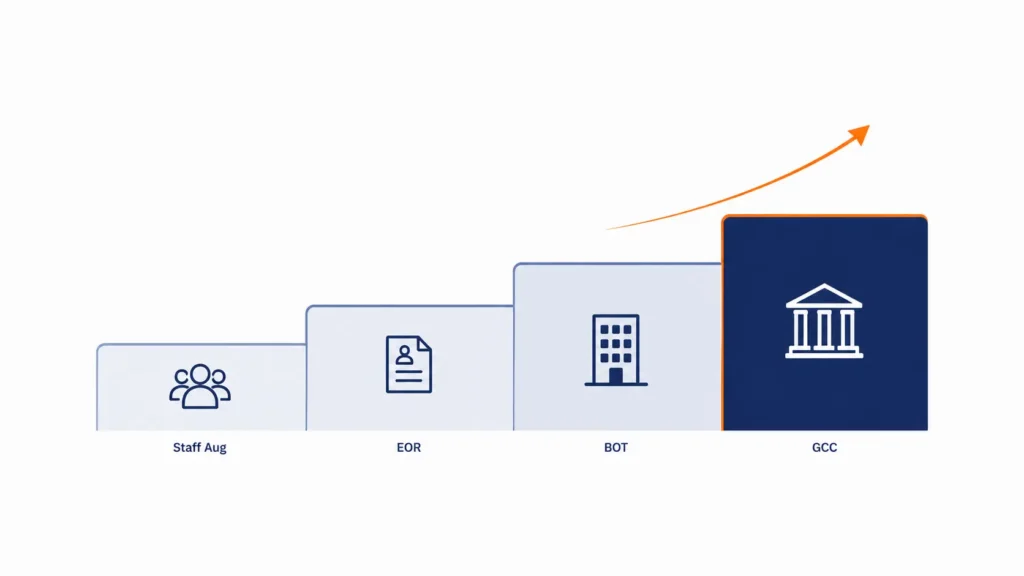
The modern spectrum of offshore engagement spans four distinct models:
- Staff Augmentation and traditional outsourcing (vendor-managed, no ownership path)
- Employer of Record (EOR) (compliance-only, no operating infrastructure)
- Build-Operate-Transfer (BOT) (staged path to ownership, two distinct modes)
- Direct Global Capability Center (GCC) (full ownership from day one)
Each model solves a different problem. Each one fails in a different way when applied to the wrong stage.
Staff Augmentation — Fast Access, Hard Ceiling
Staff augmentation is the default first move for most founders. You need engineers fast. A vendor provides them within weeks. Your team manages them directly. The engagement is flexible and easy to scale down.
In the right context, it works well. For isolated skill gaps, short-term modules, or quick validation sprints, augmentation delivers exactly what it promises.
But it breaks down fast when your work becomes core product.
Why it breaks at scale:
- The ticket-mentality problem. Augmented engineers are structurally incentivized to complete assigned tasks, not solve product problems. They write code to satisfy QA parameters. They do not own architecture decisions or long-term product health. Context lives in their heads, not in the system.
- Knowledge drain. When an augmented engineer leaves (and they will), institutional knowledge leaves with them. Every departure sets the team back four to eight weeks in delivery time and increases technical debt accumulation by measurable amounts. Organizations with annual turnover above 20% lose an average of 42% of project-specific knowledge.
- Coordination collapse at scale. Adding isolated resources to complex AI or data engineering projects multiplies handoff friction exponentially. Progress becomes uneven. Modules advance while dependencies stall. You are not short on engineers. You are short on unified execution.
- The cost math breaks. Vendor margins typically run between 40% and 70% above the engineer’s base compensation. Costs scale linearly. There are no economies of scale. The model that looked efficient at five people becomes a structural penalty at thirty.
Research Finding: Augmentation is highly effective for fulfilling isolated skill gaps. It systematically breaks down when used to execute core product strategies or scale complex architectural initiatives. The failure is not a management problem. It is a structural incentive problem.
EOR — Compliance Speed, No Operating Depth
The Employer of Record model has grown quickly. It solves a real problem: how do you hire engineers in a foreign jurisdiction without registering a legal entity there?
The EOR provider becomes the legal employer in the target country. They handle payroll, tax withholding, and local labor law compliance. You manage the work. They handle the administration.
When it works:
- Small cohort of distributed engineers in a remote-first org
- Testing a jurisdiction before committing capital
- Avoiding permanent establishment risk in early exploration
When it breaks:
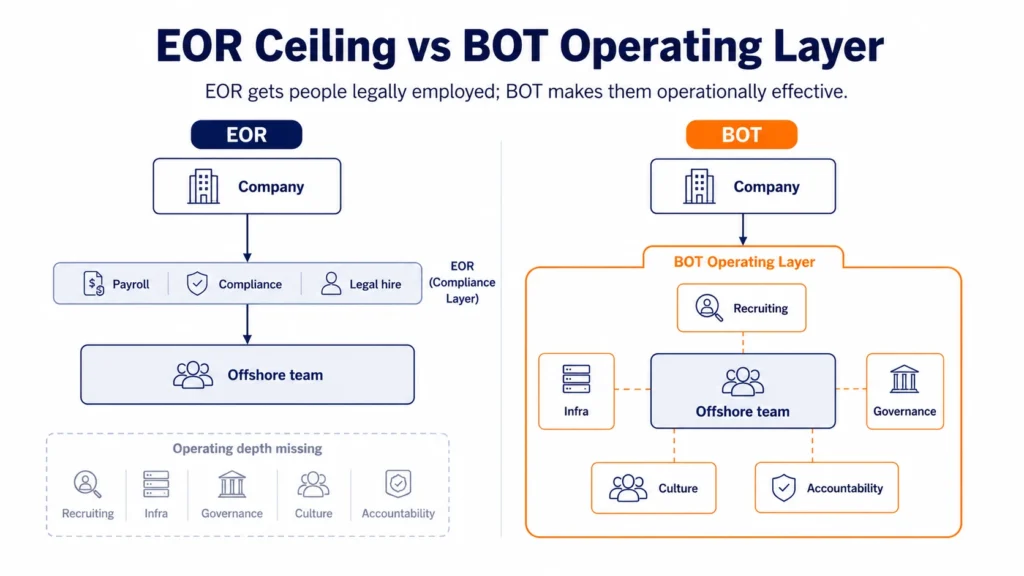
The EOR model has one hard limit: it is a compliance layer, not a capability model. It does not provide physical workspace, IT infrastructure, talent acquisition strategy, performance management, or cultural rituals. There is no operating backbone behind your offshore engineers.
When your remote EOR talent lacks cohesion, shared output, and brand identity, that is the signal. You have outgrown compliance-only and need operational depth.
| Capability Dimension | EOR | Managed GCC / BOT |
|---|---|---|
| Core function | Legal employment and payroll processing | End-to-end operational execution |
| Talent strategy | Client handles all recruitment | Partner executes targeted acquisition |
| Infrastructure | No workspace or IT provisioning | Dedicated physical workspace and enterprise IT |
| Cultural integration | Minimal. Talent remains isolated | High. Partner drives localized employer branding |
| Accountability | Purely statutory and regulatory | Shared accountability for product outcomes |
The EOR model enables fast market entry. It is not designed to build an enduring engineering hub. When an organization recognizes that its EOR team has no cohesion or shared mission, that is the signal to move to a model with real operating depth.
BOT in Project Delivery — For Pre-Revenue and MVP Companies
Build-Operate-Transfer runs in two distinct modes. Understanding the difference will save you from choosing the wrong engagement type at the wrong time.
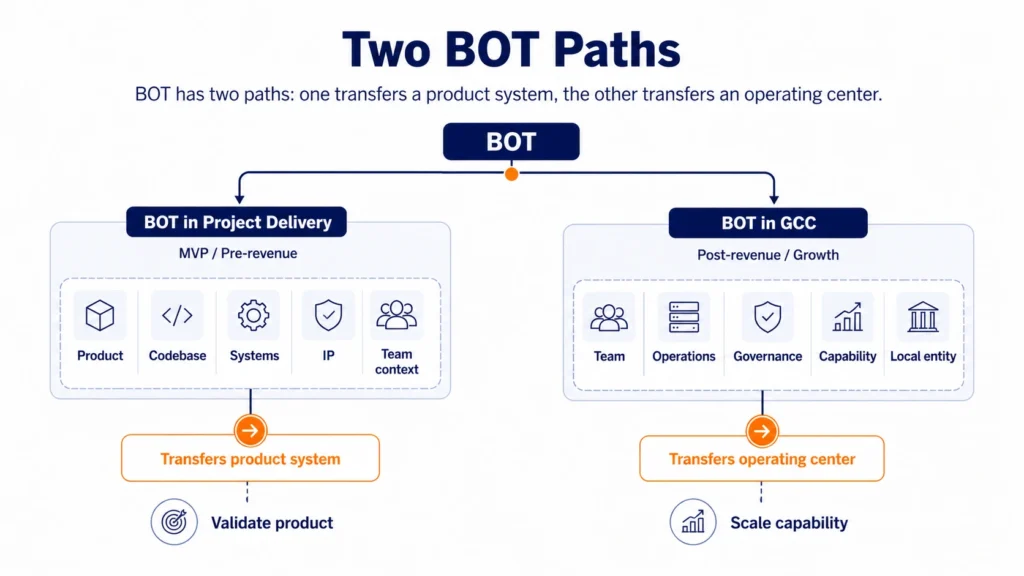
The first mode is BOT in Project Delivery. This is built for companies that are still validating the product.
What makes it different from outsourcing:
A traditional vendor executes a fixed scope. BOT in Project Delivery is a co-building model. The partner brings product thinking, engineering discipline, documentation standards, and transfer-ready foundations from day one. When the market tells you something different from your original spec (and it will), a BOT partner recalibrates with you. A fixed-scope vendor issues a change order.
What transfers at the end:
The product, the codebase, the institutional knowledge, and the team itself. This is not a service hand-off. It is a structured transition of a working system with the full context to run it.
Best fit signals:
- You are pre-revenue or still validating the product
- Your requirements are evolving rapidly
- You need engineering discipline and documentation, not just headcount
- You want the option to transfer the IP, product, and team later
- You need execution urgency, not a managed services vendor
The staff augmentation comparison:
With augmented staff, your team manages, directs, and holds all context. With BOT in project delivery, you get a cohesive team with its own operating system, governance, and retention infrastructure. The team owns outcomes, not just tasks.
Key Distinction: BOT in Project Delivery is not a vendor relationship. It is closer to a co-founder model with a built-in exit path to ownership. The product, systems, and institutional knowledge transfer to you. Not the vendor.
BOT in GCC — For Post-Revenue to Expansion-Stage Companies
The second mode is BOT in GCC. This is built for companies with traction that need a dedicated offshore team they will eventually own.
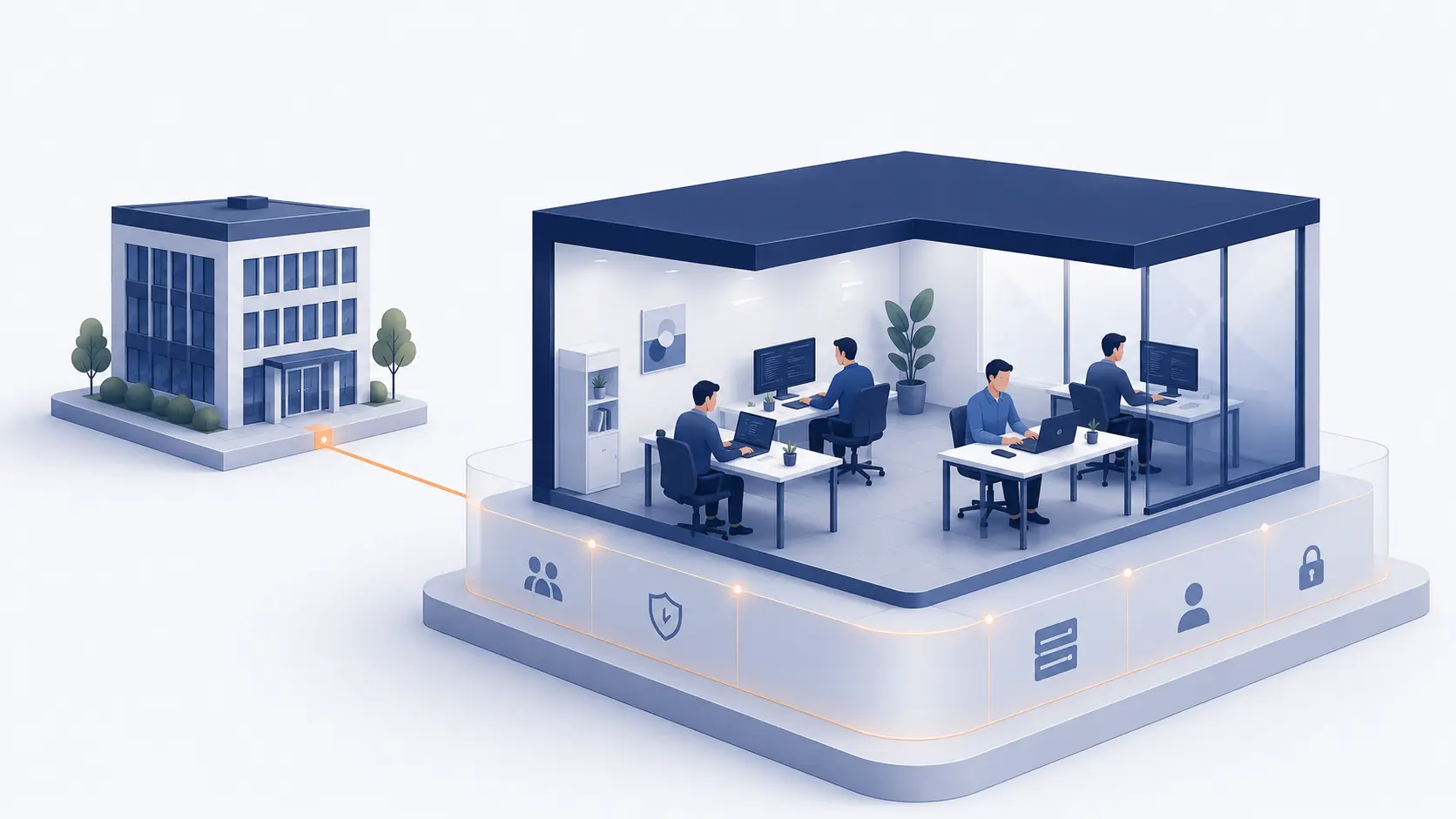
In this model, the partner builds a capability center inside its existing operating environment. You get a subsidiary-like experience without registering a foreign legal entity on day one. The partner handles everything operational:
- Hiring systems and multi-stage technical assessment
- HR lifecycle management, payroll, and statutory compliance
- Physical infrastructure, IT, and security governance
- Delivery governance, sprint integration, and SLA management
- Documentation, knowledge management, and retention programs
- Transfer readiness planning throughout the engagement
You manage the work. The partner manages everything else.
What transfers at the end:
The full team, the operations, and in many cases, the local entity itself. You inherit a compliant, documented, high-retention offshore operation with no startup costs, no wrong hires, and no regulatory surprises.
| Dimension | BOT in Project Delivery | BOT in GCC |
|---|---|---|
| Best fit | Pre-revenue, MVP, early product | Post-revenue, PMF, growth stage |
| Focus | Co-building, fast iteration, transfer-ready | Dedicated offshore team, long-term |
| Team size | Small, focused pods (5-30 engineers) | Scales to 20-100+ FTEs |
| Transfer outcome | Product, systems, and IP to client | Full team, operations, and entity to client |
| Closest comparison | Not a vendor; closer to a co-founder | Not outsourcing; a subsidiary you will own |
Best fit signals:
- Post-revenue traction and a validated product
- A dedicated offshore team you plan to own eventually
- Not ready to register a foreign legal entity
- Need HR, payroll, compliance, infrastructure, and security covered by a partner
- Cannot absorb the management distraction of a direct GCC build
Direct GCC — For Mature, Heavily Capitalized Companies
When it compounds in value: absolute IP control, deep cultural alignment, superior talent magnetism over time, and no vendor margin eating into your unit economics. Research suggests mature GCCs deliver a 40% to 60% reduction in operational costs and up to 20% improvement in EBITDA at full maturity.
A direct GCC is a wholly owned foreign subsidiary operating as a legal extension of your company. It is the highest-control, highest-commitment model available.
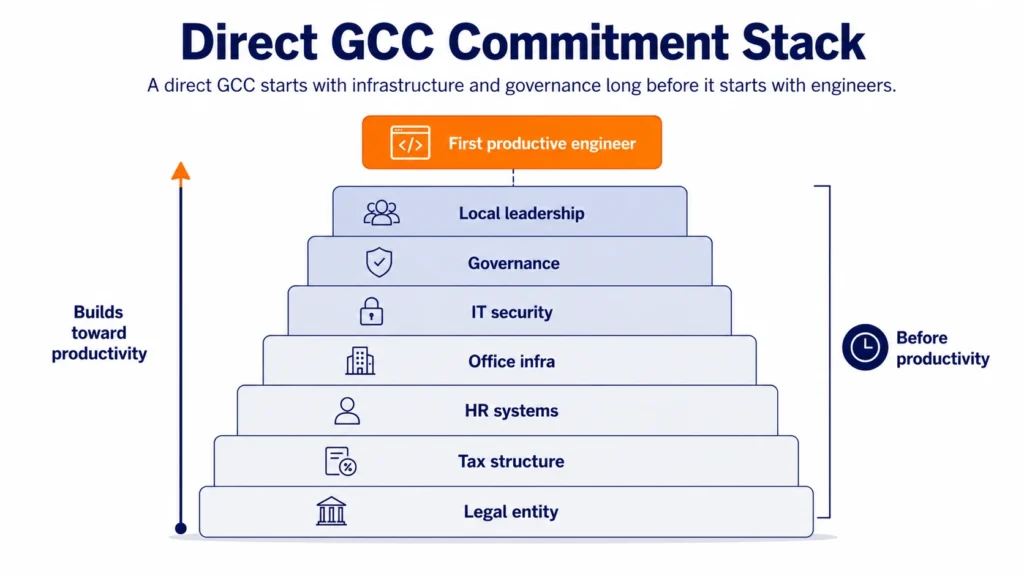
What you are actually committing to before a single engineer starts:
- Location strategy and multi-city feasibility analysis
- Legal entity registration (PLC, LLP, or Branch Office): 60 to 90 days minimum
- Tax structuring and transfer pricing compliance
- Local labor law and employment frameworks
- HR policies, payroll systems, and statutory filings
- Physical office lease, fit-out, and IT infrastructure
- Security architecture (ISO 27001, HIPAA, SOC2 as applicable)
- Organization design and operating frameworks
- Local leadership hiring (the highest-risk, slowest step in the entire sequence)
- Culture-building and HQ coordination systems
Each item above is its own workstream. Combined, they run 9 to 18 months before your first productive engineer. The upfront CapEx for a 50-to-100-person center runs from $500K to $1.25M before you factor in wrong leadership hires or regulatory surprises.
Direct GCC is only justified when:
- You have $1.2M to $4M in available upfront capital and internal legal bandwidth
- You already understand the target location, leadership structure, and compliance framework
- You are ready for a 9 to 18-month setup timeline
- You are a mature enterprise with international expansion experience
- You have a multi-year scaling roadmap, not just a six-month headcount target
Warning: Premature direct GCC setup is one of the most expensive mistakes a technology leadership team can make. The problem is not obvious at first. You book office space. You register the entity. You make your first hires. Everything looks like momentum. But the foundational questions about governance, capability ownership, and HQ integration were never answered. The center devolves into a high-attrition cost hub within 18 months.
The Stage-Based Decision Framework
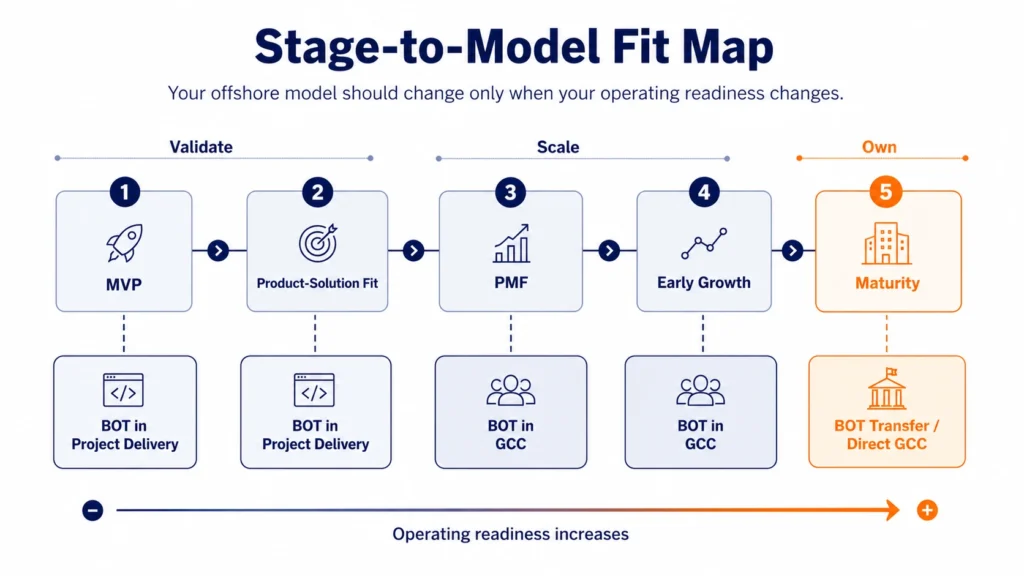
The right offshore model is not a permanent decision. It tracks your company’s lifecycle stage. Use this framework to match your current situation to the right model.
| Company Stage | Best-Fit Model | Main Goal | Why This Model |
|---|---|---|---|
| MVP / pre-revenue | BOT in project delivery | Build product and transfer-ready foundations | Zero CapEx entry, co-building discipline, transfer-ready IP from day one |
| Product-solution fit | BOT in project delivery | Faster iteration with stronger engineering discipline | Partner absorbs operational friction; team scales with the product |
| PMF / post-revenue | BOT in delivery or BOT in GCC | Scalable, accountable engineering | Transition from isolated delivery to dedicated offshore pod with shared accountability |
| Early growth | BOT in GCC | Stable offshore operating unit | Managed capability center with full operational layer; no entity complexity on the client |
| Expansion | BOT in GCC | Multi-capability offshore center | Partner scales real estate, recruitment aperture, and compliance as center expands |
| Maturity | BOT transfer or direct GCC | Owned global capability | Full legal and operational ownership; offshore center becomes a captive strategic asset |
The model does not change arbitrarily. What changes is the operating design, team size, and how much of the operating system you are ready to own.
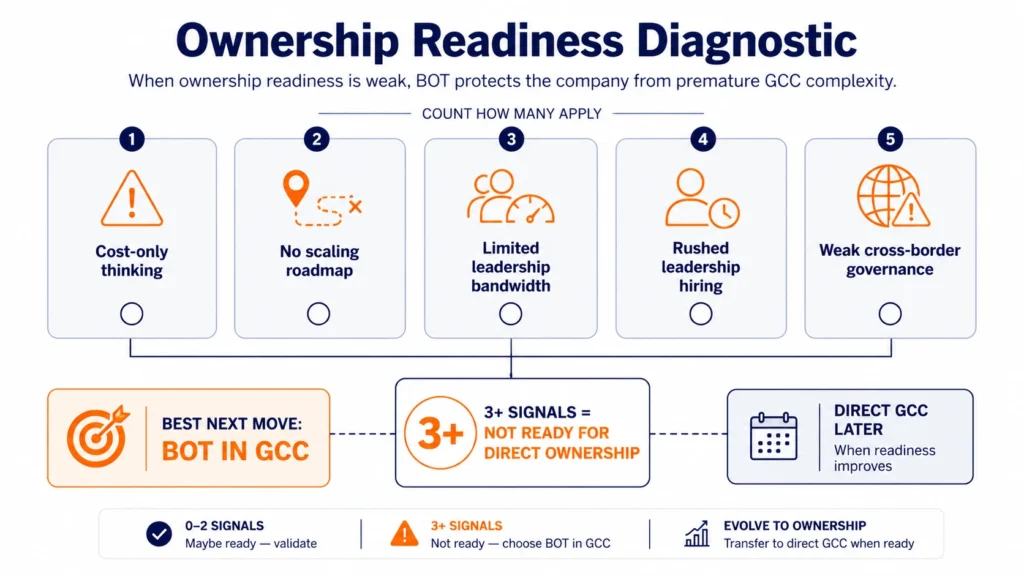
Five Signals You Are Not Ready for Ownership
Before you commit to direct GCC ownership, or trigger the transfer phase of a BOT engagement, run this diagnostic. These signals indicate your organization is not ready.
- You evaluate offshore purely on cost per headcount. If the board measures offshore success solely through cost arbitrage, the organization is not ready for a captive center. Modern offshore hubs are capability engines. They require continuous investment in employer branding, workspace quality, and talent development. Cost-first mindsets create high-attrition outposts, not capability centers.
- You have no multi-year scaling roadmap for the offshore unit. Organizations that plan only to “hire 30 people quickly and figure the rest out later” are wholly unprepared for ownership. A real GCC requires projected maturity roadmaps: multi-year engineering pipelines, scale projections, leadership succession plans, and innovation ownership models from day one. Without this foresight, the structure fractures.
- Your leadership lacks bandwidth to manage remote compliance and culture building. If your CTO is already stretched thin managing domestic delivery, adding a foreign entity and all its administrative weight will not free up capacity. It will create more drag. The BOT Operate phase exists precisely to handle this weight while you validate the model.
- You are optimizing for headcount speed over leadership quality. In a GCC, the first three hires determine the culture, tone, and standard of excellence far more than the next three hundred combined. The center head and initial management layer are the connective tissue between the local hub and global headquarters. Rushing these hires to meet a quarterly target embeds mediocrity permanently.
- Your headquarters has no governance model for cross-border collaboration. A captive center cannot function in a silo. If onshore teams resist relinquishing control over engineering modules, or if cross-border communication is unstructured and reactive, the center will fail regardless of how strong the local talent is. Ownership readiness requires robust governance at HQ, not just a capable team offshore.
Diagnostic Summary: If three or more of these signals apply to your company right now, the right move is BOT in GCC, not direct ownership. Validate the model first. Transfer when the capability is stable, documented, and proven.
One Question to Ask Before You Decide
The most important question is not “which country?” or “how many engineers?” It is this:
Are you building a team, or building a capability you will eventually own?
If the answer is “a team for now, ownership eventually,” BOT is your model. Start with the mode that matches your stage. Pre-revenue, use BOT in project delivery. Post-revenue with growth ambitions, move to BOT in GCC. Transfer when your team, processes, documentation, and business case are ready.
If the answer is “full ownership immediately, no interim phase,” that is a direct GCC. Make sure you have the capital, the local expertise, and the multi-year leadership bandwidth to justify it.
The wrong answer is “we will outsource now and figure the rest out later.” That path rents capacity indefinitely, bleeds institutional knowledge with every contractor rotation, and leaves you starting from zero when you finally decide you need to own something.
The BOT Path to GCC: A Founder’s Guide
Get the complete founder’s playbook on
Build-Operate-Transfer.
Includes:
BOT framework, readiness checklist & case study