TL;DR
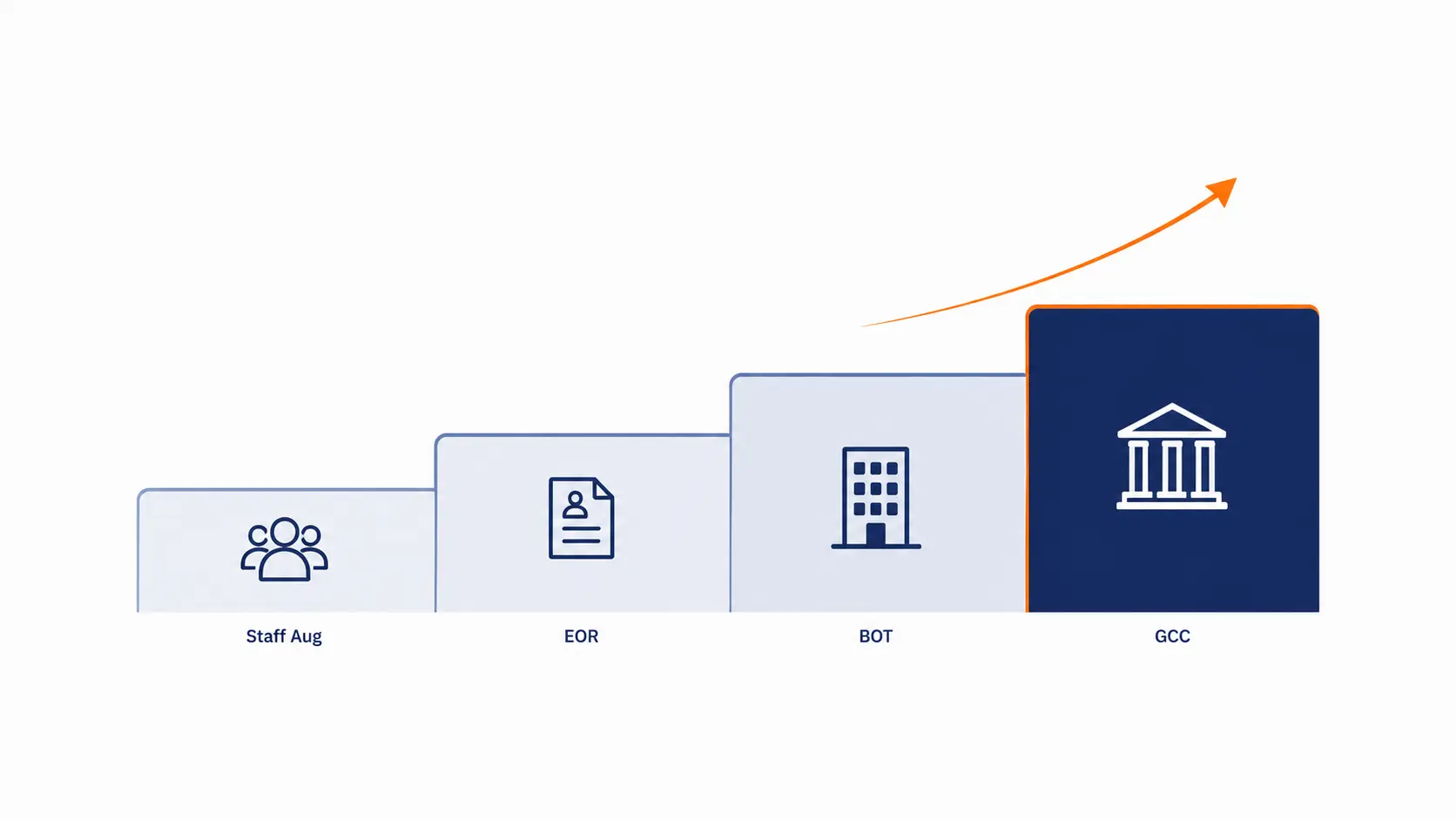
- Each offshore model serves a different need. Outsourcing and staff augmentation fit transactional or short-term capacity goals. Direct GCC setup burns 12–18 months and up to $2M before a single engineer ships production code. SubaaS fills the gap in between.
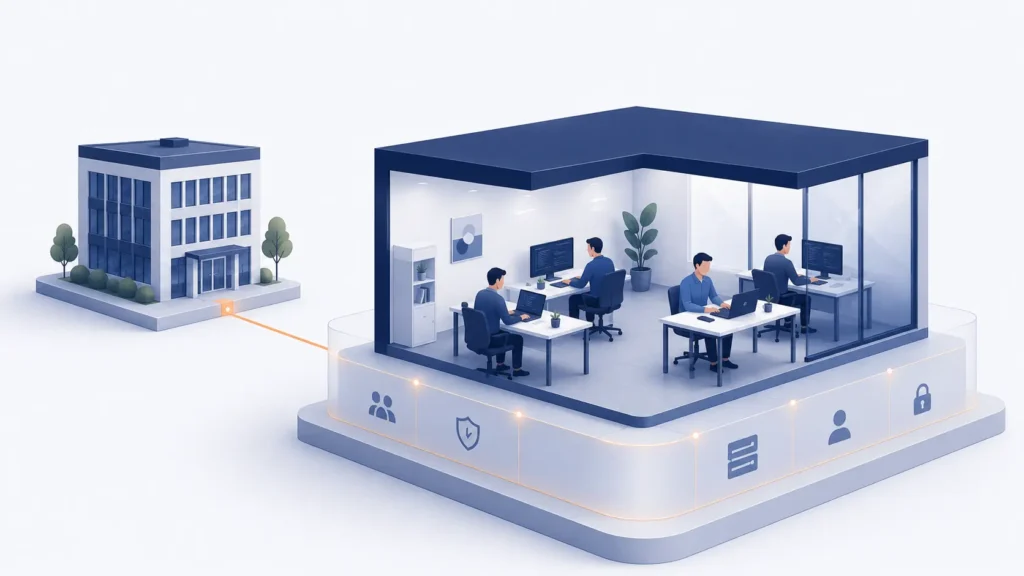
- Subsidiary-as-a-Service (SubaaS) is a staged model. You operate inside a partner’s infrastructure, then transfer the entire capability to a wholly owned entity when you are ready.
- The Build-Operate-Transfer (BOT) sequence compresses the setup phase from 12+ months to 4–8 weeks of productive ramp.
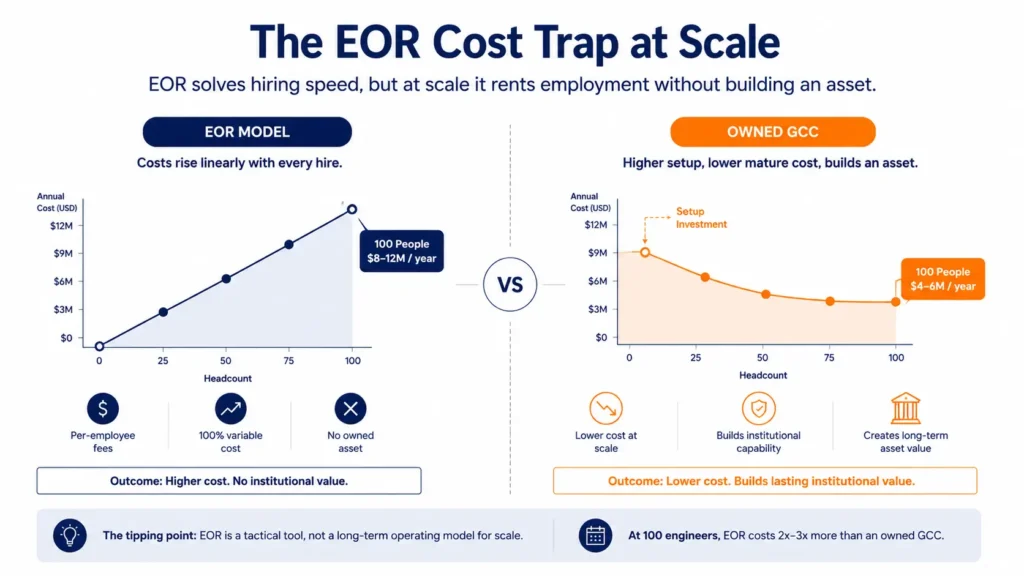
- The Employer of Record (EOR) model is a financial trap at scale. A 100-person EOR team costs $8–12M annually versus $4–6M for a mature owned Global Capability Center (GCC).
- Nepal is emerging as a high-retention alternative to India and Vietnam. Voluntary attrition in top-tier Nepali firms sits at approximately 8%, against 12–17% at major Indian IT services companies.
- Transfer-readiness must be designed from day one. If it is bolted on at exit, the handover yields a hollow shell, not a functional capability center.
A Structural Gap in Offshore Expansion
Many growth-stage technology companies reach a point where the domestic talent market becomes a constraint. Hiring timelines lengthen. Compensation pressures grow. Product velocity slows. For these organizations, building an offshore engineering capability becomes a serious strategic question.
When that question surfaces, two paths tend to dominate the conversation.
The first path is outsourcing or staff augmentation. Both are fast to start and carry low initial setup costs. Each serves a legitimate purpose. Staff augmentation works well when you already have strong internal engineering management and need to add capacity quickly. Outsourcing works when you want a vendor to own a defined outcome. Where these models create friction is when a company needs a long-term, transfer-ready capability that feels and operates like an owned team.
The second path is building a direct Global Capability Center. It delivers full operational control and IP security. It also requires $500,000 to $2,000,000 in upfront capital, 60–90 days just to register a legal entity, and 12–18 months before the first engineer ships production code. For a Series B or Series C company, that timeline can be a significant diversion of executive bandwidth.
The structural gap: For companies that want more control than outsourcing offers but are not yet ready to absorb the full administrative and capital burden of a foreign entity, neither path fits cleanly.
Subsidiary-as-a-Service, executed inside a Build-Operate-Transfer framework, is designed specifically for that gap.
What Subsidiary-as-a-Service Actually Means
Subsidiary-as-a-Service is not a legal classification. It is not a clever rebrand of outsourcing. It is a specific operating model where a parent company builds an offshore engineering capability inside a partner’s existing infrastructure, compliance system, and governance layer. The client directs the work. The partner runs the local machinery.
The analogy is cloud computing. Twenty years ago, launching a software product required procuring physical servers and negotiating data center space. Today, companies rent managed cloud infrastructure, validate their workloads, and only repatriate server infrastructure when scale demands it. SubaaS applies this same abstraction to global corporate operations.
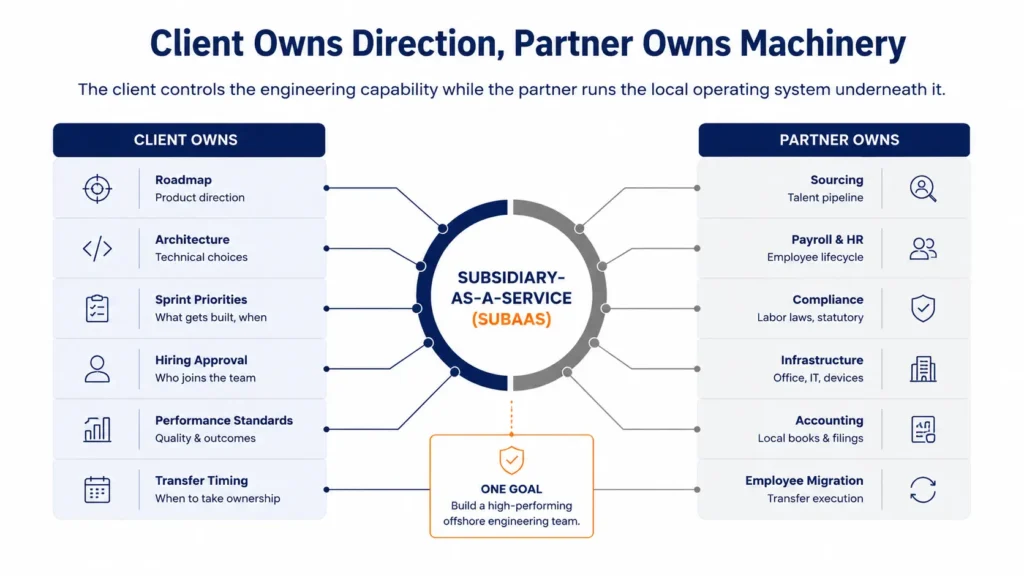
The control split is precise and non-negotiable.
| Responsibility Zone | Client Owns | Partner Owns |
|---|---|---|
| Product direction | Roadmap, architecture, sprint priorities, quality bar | — |
| People | Final hiring decisions, culture integration, performance standards | Sourcing engine, payroll, HR lifecycle, statutory compliance |
| Infrastructure | — | Physical office, IT stack, security certifications, device management |
| Finance | Single vendor invoice | Local accounting, tax filings, payroll processing |
| Transfer | Transfer decision and timing | Employee migration, IP handover, SOP documentation |
This split is materially different from outsourcing, where the vendor owns delivery outcomes. It is also different from staff augmentation, where the client inherits management burden without getting a functional offshore operating system in return.
Understanding the Model Fit Problem
When Outsourcing and Staff Augmentation Work Well
Staff augmentation and outsourcing are legitimate models. They are optimized for specific scenarios and perform well in those contexts.
Staff augmentation is the right choice when:
- You have strong internal engineering leadership with capacity to manage day-to-day task direction.
- You need to add specific skills or headcount quickly for a defined period.
- Retaining long-term institutional knowledge in the offshore team is not the priority.
Traditional outsourcing or project-based delivery is the right choice when:
- Requirements are well-defined and relatively stable.
- You want the vendor to own delivery outcomes, not just seat-fill.
- You do not intend to bring the capability in-house over time.
Where both models create friction is when a company’s needs shift. When an organization wants a long-term, dedicated team that integrates into the product culture, retains deep context over time, and can eventually be transferred into a wholly owned entity, the structural design of both models works against that goal. Staff augmentation was not built for knowledge compounding. Project outsourcing was not built for ownership transfer.
The Direct GCC Setup Burden for Growth-Stage Companies
The upfront cost and complexity of a direct GCC build stops most growth-stage companies before they start.
| Setup Phase | Timeline | Key Requirements |
|---|---|---|
| Legal entity registration | 60–90 days minimum | Corporate secretary, foreign board, capital requirements |
| Tax and transfer pricing structure | Parallel to registration | Benchmarking studies, arm’s length documentation |
| Office leasing and facility fit-out | 30–60 days post-registration | Commercial real estate, enterprise IT architecture, security certs |
| Leadership recruitment | 60–120 days | Country head, engineering directors, HR executives |
| Total before first line of production code | 9–18 months | Full executive bandwidth consumed |
Source: BOT Path to GCC
A mis-hire at the foundational leadership layer can set the entire operation back by a full fiscal year. For a Fortune 100 enterprise, this is an acceptable cost. For a Series B company trying to maintain product momentum, it is a critical diversion of founder attention.
The EOR Financial Trap
The Employer of Record model has surged in popularity as a shortcut around both extremes. An EOR lets a company hire in a foreign jurisdiction legally, with the EOR acting as the local legal employer on paper. It is fast to start, often deploying individual hires within 24 hours.
But EOR is a tactical employment solution, not a strategic capability builder. The financial reality becomes untenable at scale.
Research Finding: The EOR financial tipping point occurs at 15-20 employees. At 100 engineers, an EOR model costs $8–12M annually. A mature, owned GCC runs the same team for $4–6M per year. EOR spend builds zero residual asset value.
EOR fees typically range from $300–$600 per employee per month, on top of salary, taxes, and benefits. Published list prices from providers like Remote and Deel run approximately $599 per employee per month before add-ons. Those fees scale linearly in cost but produce no compounding institutional return.
The Build-Operate-Transfer Sequence
SubaaS achieves its full strategic value inside a three-phase BOT framework. The GCC is the destination. BOT is the vehicle. SubaaS is the engine running the operational phase.
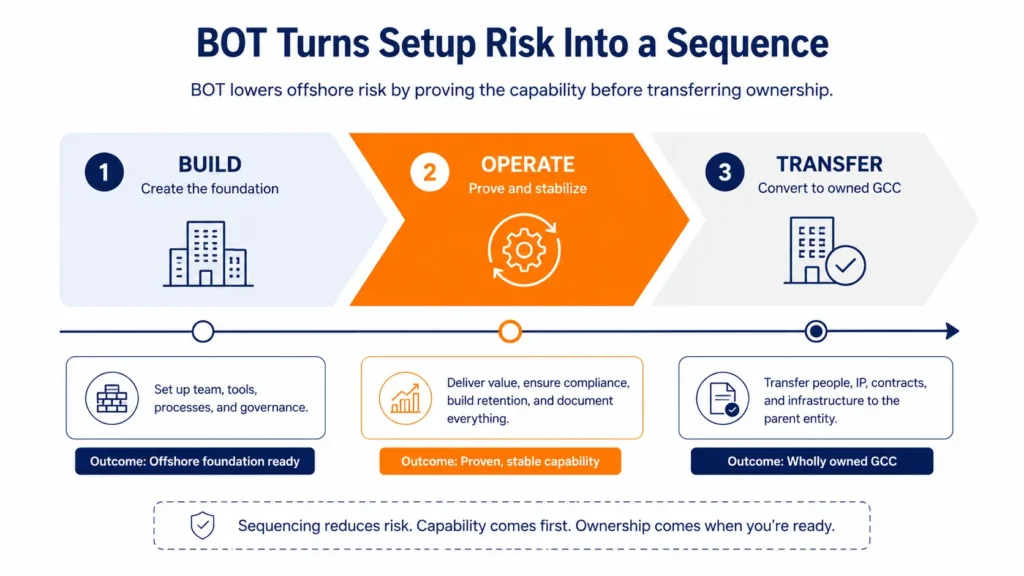
Phase 1: Build (Weeks 0–8)
The partner stands up the offshore foundation in a fraction of the time required for a direct setup. Key activities:
- Role architecture, hiring plan design, and candidate sourcing using proprietary talent pipelines.
- Technical assessments and cultural alignment reviews, with the parent company retaining final hiring authority.
- Secure IT infrastructure setup, physical workspace configuration, and compliance readiness.
A process that takes 9–18 months in a direct GCC build compresses to 4–8 weeks of productive ramp. Upfront capital expenditure is zero.
Phase 2: Operate (Months 2–18+)
The partner runs the full operating system. The parent company focuses on product outcomes.
- Partner manages: payroll, HR lifecycle, statutory compliance, IT infrastructure, physical security, and retention programs.
- Client manages: sprint delivery, architectural standards, product roadmap, and team integration.
The parent company enjoys the stability and output of an owned subsidiary without bearing the legal risk or capital drain of actually owning one.
Phase 3: Transfer (Months 9–36)
This is what distinguishes SubaaS from perpetual outsourcing. When the capability is mature and the business case is proven, ownership transfers cleanly to the parent company.
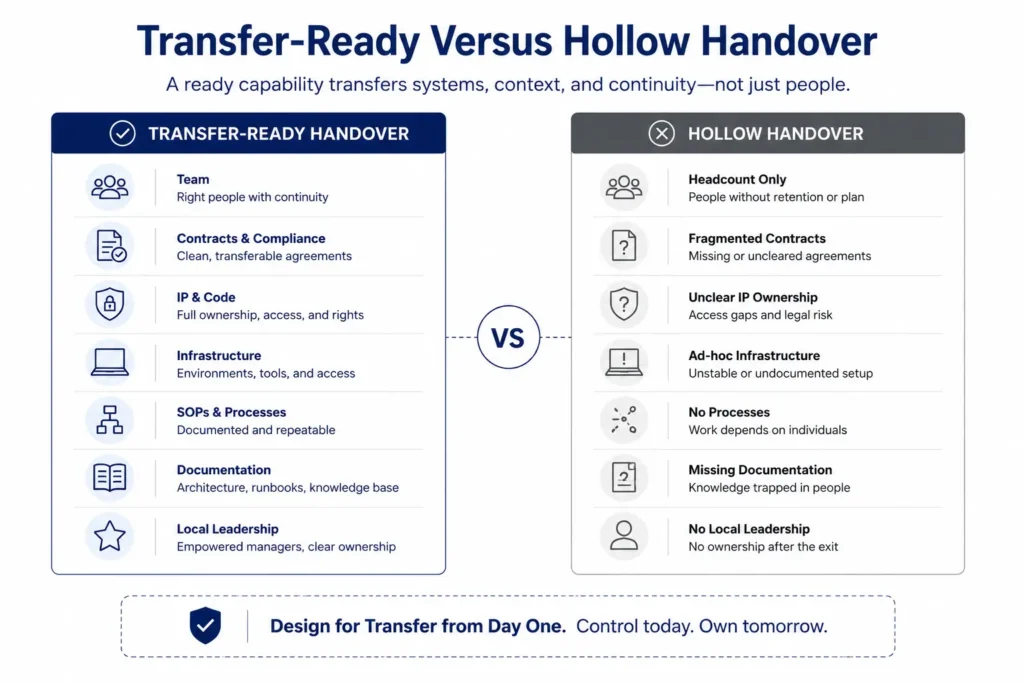
The handover is comprehensive. It includes:
- The full engineering team, employment contracts, and retention terms.
- Localized intellectual property, code repositories, and documentation.
- Physical and technological infrastructure.
- Standard Operating Procedures (SOPs) and delivery playbooks.
- A fully developed local leadership layer.
The parent company inherits a functional GCC that has already bypassed the chaotic startup phase.
The BOT Path to GCC: A Founder’s Guide
Get the complete founder’s playbook on
Build-Operate-Transfer.
Includes:
BOT framework, readiness checklist & case study
The Security and Compliance Layer
For companies in healthcare, fintech, insurance, or defense, security is non-negotiable from day one.
A mature SubaaS provider operates under internationally recognized frameworks including ISO 27001:2022 and SOC 2 Type II, and aligns with HIPAA requirements. These are not marketing certifications. They require structural implementation across six defense layers:
- Operational Security: Information security policies, secure onboarding and offboarding, and risk assessments.
- Physical Security: 24/7 CCTV, biometric access controls, and redundant power systems.
- Identity and Access Management: Principle of least privilege, Role-Based Access Control, and mandatory multi-factor authentication.
- Endpoint Security: Active endpoint detection and response, remote wipe capability, and encrypted drives.
- Network Security: VLAN segregation, real-time threat monitoring, and VPN enforcement.
- Data Security: Encryption at rest and in transit, and Data Loss Prevention protocols.
One underestimated risk deserves specific attention: AI coding tools used by offshore developers. Tools such as GitHub Copilot transmit code snippets and potentially raw Protected Health Information (PHI) to external cloud servers for processing. These tools do not execute Business Associate Agreements (BAAs). Any transmission of protected data constitutes a federal compliance violation.
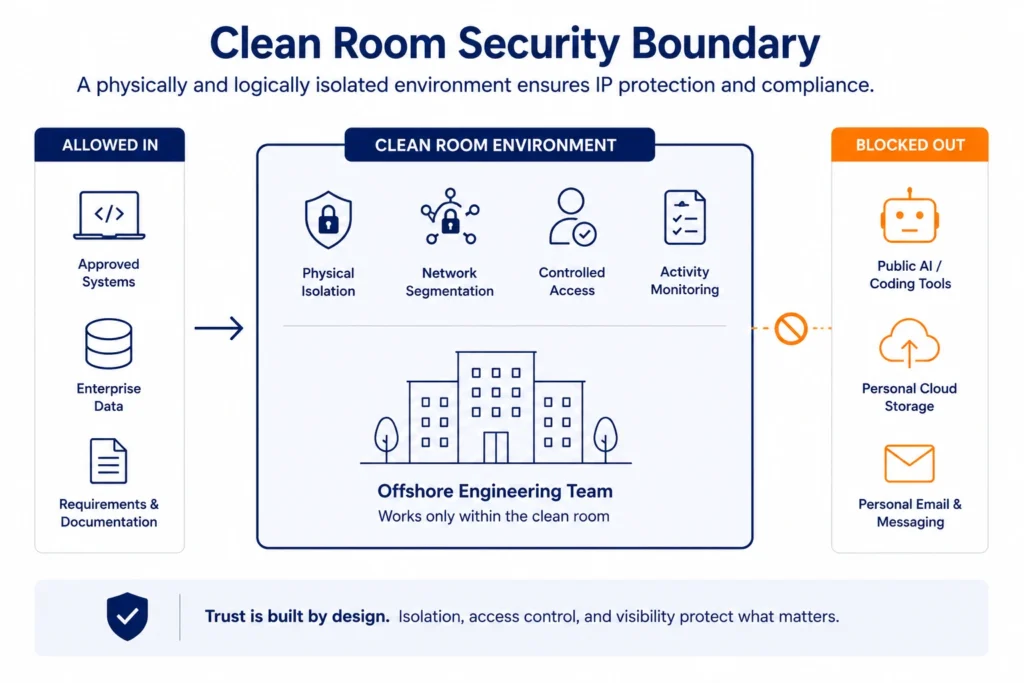
Pro-Tip: A premier SubaaS partner enforces “Clean Room” protocols. These are physically and digitally segmented environments where unapproved AI coding tools are blocked at the network level. This is verifiable. Ask for the ISO certificate scope, BAA templates, and incident process documentation before signing anything.
Tax Exposure During the Operate Phase
When a parent company owns a foreign subsidiary, any transactions between the two entities typically trigger transfer pricing obligations under local tax law. Most jurisdictions require that these transactions reflect a fair, arm’s length commercial value. Meeting that standard requires formal benchmarking studies, detailed documentation, and continuous exposure to the host country’s tax authority. Non-compliance can result in double taxation, upward adjustments to tax liabilities, and protracted audits.
SubaaS eliminates this exposure during the Build and Operate phases. Because the partner is a third-party vendor, the commercial relationship is treated as a standard business-to-business contract, not an intra-group transaction. The parent company pays a single, predictable invoice. Transfer pricing obligations only arise when the parent company formally establishes its own legal entity during the Transfer phase. By that point, years of actual operational data make cost-plus modeling accurate and defensible, rather than theoretical.
Geography Matters: Choosing the Right Hub
The traditional offshore calculus focused entirely on cost arbitrage. That model is broken. The relevant metric is now the velocity-to-cost ratio: the intersection of engineering proficiency, talent retention, and budget predictability.
| Market | Senior Developer Rate | Voluntary Attrition | Wage Inflation (2025) | Key Risk |
|---|---|---|---|---|
| India | $40–$60+/hr | 11.9%–16.9% | 9.5% compounding | Hyper-saturation, title inflation, bait-and-switch staffing |
| Vietnam | $30–$40+/hr | High (shortage-driven) | High (deficit-driven) | Deficit of ~200,000 engineers, quality fade risk |
| Nepal | $28–$40/hr | ~8% (est.) | Moderate, predictable | Smaller talent pool at enterprise scale |
Sources: Techkraft, Comparative Analysis and Ataraxis Global Outsourcing Talent Index, Nepal
India’s attrition figures deserve context. Major Indian IT services firms posted annualized attrition in the low teens in FY24: approximately 12.7% at Infosys, 13.3% at TCS, 14.2% at Wipro, and 12.8% at HCLTech. These are public-company disclosures, not vendor claims. For a BOT transfer model, where documentation continuity and leadership stability compound over 24–36 months, even a 5–6 point attrition difference creates a significant structural advantage. [Techkraft SubaaS Research Report, GPT Analysis]
Nepal’s technology ecosystem has matured rapidly. IT service exports surged over 64% since 2021. The country now hosts more than 100,000 tech professionals generating over $1 billion in annual IT exports. Nepal recently ranked 19th globally in the Ataraxis Global Outsourcing Talent Index, scoring 96 out of 100 on labor cost competitiveness.
The Nepalese government has also reinforced this position with a 75% tax rebate on income from IT service exports and a 5% final tax rate for individual IT exporters. These incentives pass financial efficiency directly to foreign partners.
Real Validation: Abacus Insights
Abacus Insights, a Boston-based healthcare data platform that had raised over $80M to serve 28+ million members, entered a BOT engagement with Techkraft in Nepal.
Their starting position:
- Multiple fragmented contractors with no shared operational goals.
- Severe communication lags and limited knowledge retention.
- Regulatory exposure from handling healthcare data without centralized compliance controls.
The outcome after 24 months under the SubaaS model:
- Scaled from 0 to 85+ full-time engineers.
- Achieved 100% SLA adherence on production workflows.
- Reduced QA cycle times by 35%.
- Validated the offshore capability and HIPAA compliance framework before committing to long-term ownership.
Most critically, Abacus avoided all upfront investment risk during the validation phase.
Is Your Organization Ready for This Model
SubaaS is the right model when all four conditions are true:
- You have validated product-market fit and a durable offshore engineering roadmap.
- You want more control and IP security than outsourcing or EOR will comfortably deliver.
- You are not yet ready to absorb the capital, legal, and administrative burden of a direct foreign entity.
- You want a contract that makes ownership transfer operationally clean, not aspirational.
It is the wrong model for pre-revenue startups needing a disposable MVP, organizations with no long-term offshore strategy, or well-capitalized enterprises with existing international legal infrastructure that can absorb a direct GCC build.
What to Demand from a Partner
The success of the BOT pathway depends entirely on the structural maturity of the provider. Evaluate on these dimensions, not on sales collateral.
| Evaluation Criteria | What to Ask |
|---|---|
| Full business function support | Can they deliver HR, finance, tax compliance, and IT, or are they an EOR with a different label? |
| Security and compliance posture | Request the ISO 27001 certificate scope, expiry date, and BAA templates. Ask for Clean Room evidence, not adjectives. |
| Empirical retention metrics | What is their documented attrition rate, with evidence, not a claim? |
| Transfer track record | Have they successfully executed a Transfer phase before? Ask for case studies and references. |
| Contract flexibility | Can you remain in the Operate phase indefinitely if macro conditions change the transfer timeline? |
| IP and transition terms | Is IP assigned at creation? Is there a defined exit and handover playbook with repository migration and service continuity obligations? |
Source: Morgan Lewis, Transition-Out Obligations
The Controlled Path Forward
The offshore model that forces founders to choose between renting capacity with no control and building a foreign entity with no operational readiness is structurally obsolete.
Subsidiary-as-a-Service, executed through a Build-Operate-Transfer sequence, resolves this directly. It allows an organization to validate its offshore operating model in real conditions, scale engineering capacity without eroding institutional memory, and execute a clean transfer to full ownership when the business is ready to absorb it.
Build the capability before you build the entity. Operate with structure before you absorb subsidiary-level risk. That sequencing is not a workaround. It is the most capital-efficient and operationally sound path to a mature, owned global engineering center.
The BOT Path to GCC: A Founder’s Guide
Get the complete founder’s playbook on
Build-Operate-Transfer.
Includes:
BOT framework, readiness checklist & case study