TL;DR
- Most offshore location decisions are over-indexed on hourly cost. That is the wrong variable.
- The right variable for BOT and GCC is continuity: how long does the team stay, and how much context do they accumulate before transfer?
- India’s mature market produces scale, but also 25 to 35% annual attrition and 9 to 10% annual wage inflation. That math punishes long-horizon capability building.
- Nepal’s engineering talent pool exceeds 100,000 professionals. The sector is growing at 20% year-on-year. IT exports crossed the $1 billion mark in 2026.
- TechKraft’s attrition rate is 8%. Senior engineers average 3.5 to 4 years of tenure. That continuity is what makes a BOT transfer valuable.
- The Abacus Insights case proves Nepal can support HIPAA-compliant, regulated global delivery at scale, going from zero to 85+ engineers in 24 months.
- Nepal is not a replacement for India. It is a high-retention, regulation-ready, BOT-optimized complement to a broader offshore strategy.
Offshore Location Decisions Are Usually Too Cost-Led
The default offshore location question is: which country is cheapest?
That question produces a short-term answer for a long-term problem.
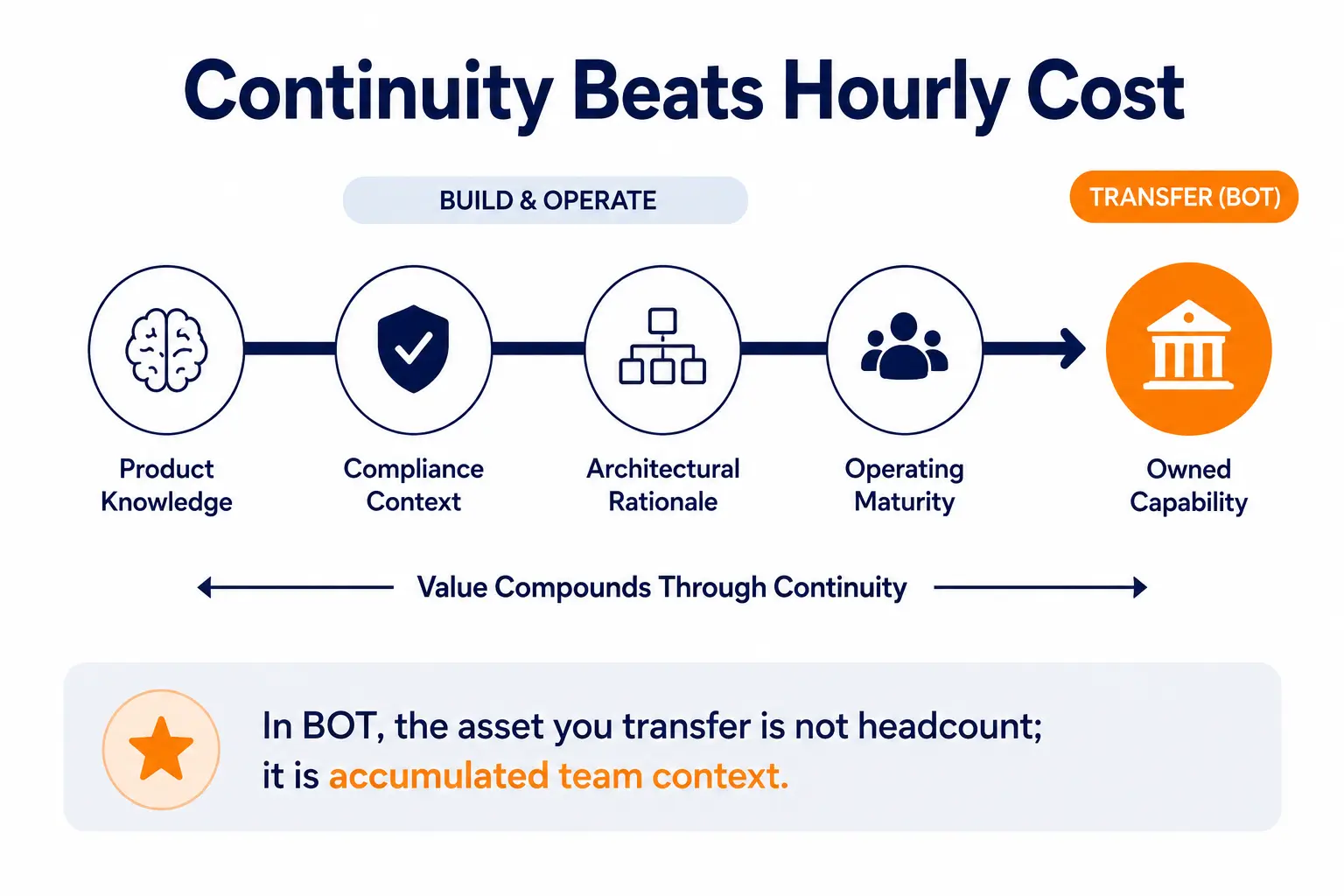
If you are hiring contractors for a fixed-scope project, hourly rate is a reasonable variable. If you are building a team you plan to eventually own through BOT, hourly rate is the least important variable on your list. The variable that determines whether your transfer is worth executing is this: how long does the team stay, and how much institutional knowledge do they accumulate before the handover?
A team that turns over every 18 months gives you bodies, not capability. The context, the architectural rationale, the domain expertise, the product history, and the cultural alignment all live in the people. When those people leave, they take that value with them. You do not transfer an asset. You transfer a headcount.
The right offshore location question for a BOT or GCC strategy is this: which location gives you the best combination of engineering depth, team continuity, compliance readiness, cost structure, and transfer potential?
That question produces a different answer.
Research Finding: For a BOT model, retention is not a nice-to-have. It is the mechanism that makes the transfer valuable. A team that churns before the transfer has nothing to hand over that a new team cannot replicate from scratch.
Why Founders Default to India, and What Problems Appear
India is the rational default for most US tech founders. The market is mature. The engineering talent pool is the largest in the world. Compliance frameworks for US-regulated verticals are established. English proficiency is high. The time zone overlap with US East Coast is workable. There are over 1,760 active GCCs already operating there.
None of those facts are wrong.
The problem is what accumulates in a mature market over time. Demand exceeds supply for senior engineers. Every major US tech company, European bank, and domestic Indian startup is competing for the same talent pool in Bangalore, Hyderabad, and Pune. That competition produces predictable outcomes.
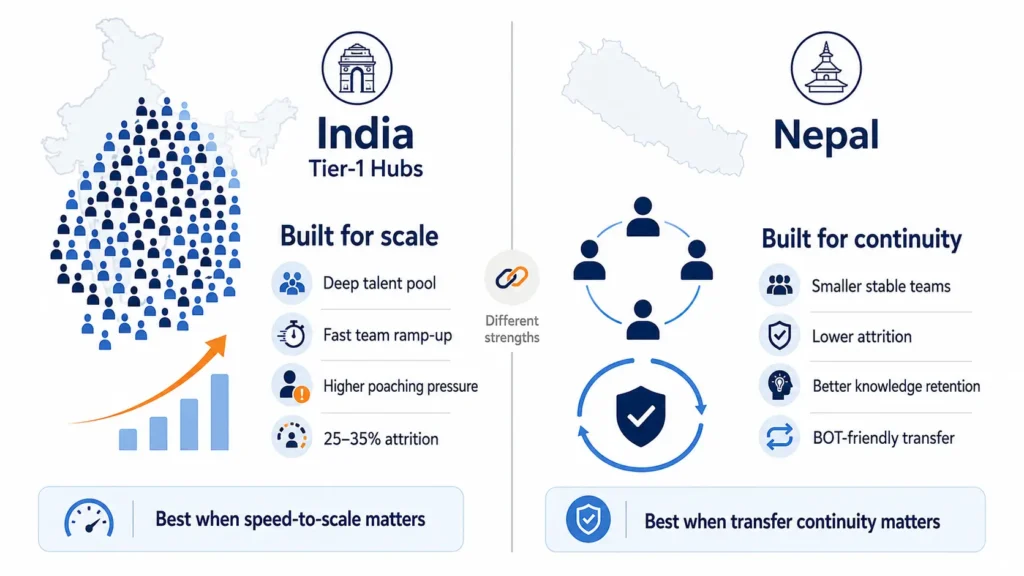
What the India numbers actually look like for a long-horizon build:
- Annual attrition in most Indian offshore firms runs 25 to 35%. In BFSI-focused operations, some firms report attrition as high as 50%.
- Wage inflation runs at 9 to 10% annually for engineering talent, compounding cost projections that looked viable at contract signing.
- Senior engineers in high-demand domains like AI, cloud, and data engineering receive multiple competing offers. Retention requires constant re-benchmarking of compensation.
- In Tier-1 cities, employers face GCC-to-GCC poaching as a structural reality, not an edge case.
None of this makes India the wrong choice. For companies that need to scale to 500+ engineers quickly, India’s depth of talent pipeline is unmatched. The problem is matching the location to the strategy.
If your goal is maximum scale in minimum time, India Tier-1 hubs are the answer. If your goal is building a high-retention team that accumulates institutional knowledge over 24 to 36 months and transfers cleanly to your ownership, the 25 to 35% attrition rate works directly against that objective.
| Location Variable | India Tier-1 (Bangalore, Hyderabad) | Nepal (Kathmandu) |
|---|---|---|
| Annual attrition | 25 to 35% industry average | 8% at TechKraft |
| Annual wage inflation | 9 to 10% for engineering talent | Significantly lower; favorable cost stability |
| Engineering cost vs US | 40 to 60% lower | 50 to 75% lower |
| GCC density | 1,760+ competing centers | Emerging; limited direct competition |
| Compliance readiness | Established frameworks | ISO 27001:2022, HIPAA-capable |
| BOT transfer suitability | High scale, moderate continuity | High continuity, optimized for transfer |
Retention Is the Hidden Economic Variable
The math of attrition is not intuitive until you put it in concrete terms.
A 25% annual attrition rate means that in a team of 40 engineers, 10 people leave every year. Each departure triggers a recruitment cycle (4 to 6 weeks minimum), an onboarding period (8 to 12 weeks before the new hire is net productive), and a knowledge gap that the remaining team has to absorb.
Research puts the cost of replacing a software engineer at 6 to 9 months of their annual salary, accounting for recruitment expenditure, training time, and lost productivity. For a team of 40, at 25% annual attrition, that is 10 replacement cycles per year running concurrently.
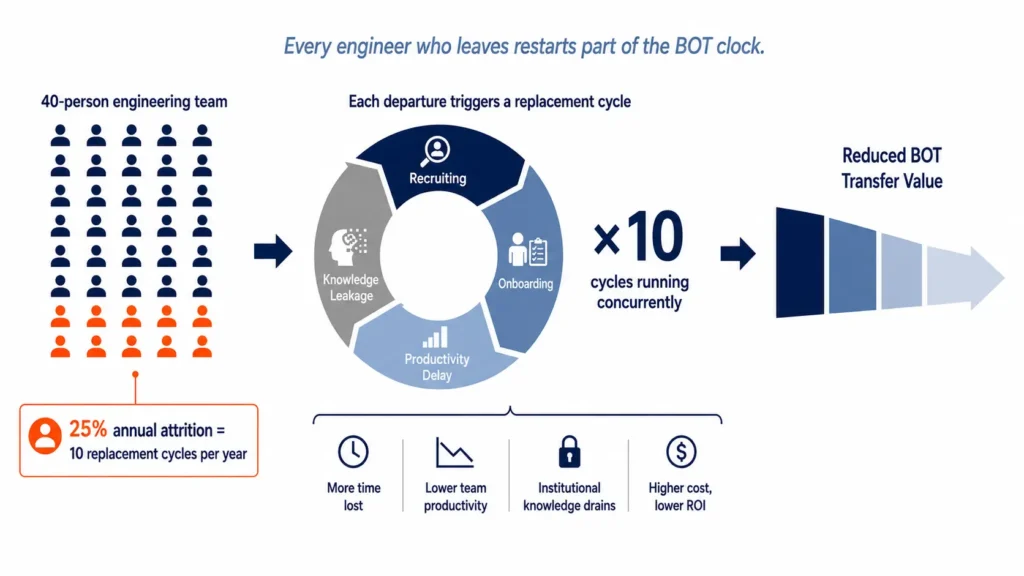
The second-order effect is more damaging. Organizations with annual turnover above 20% lose an average of 42% of project-specific knowledge. That knowledge does not live in Confluence. It lives in the engineers who made the architecture decisions, who know why the API works the way it does, who remember the edge case that caused the production outage in Q2. When those engineers leave, the team inherits a system it only partially understands.
In a BOT engagement specifically, this has a direct consequence. The transfer value of a BOT engagement is directly proportional to the institutional knowledge the team has accumulated. A team that has turned over half its membership in 24 months has accumulated far less than a team where most engineers have been there from the beginning. You are not transferring a capability. You are transferring a partial version of one.
Key Metric: Senior engineers at TechKraft average 3.5 to 4 years of tenure. In a mature market, the average sits closer to 18 months before a competitive offer pulls a senior engineer away. That 2-plus year difference is not a soft benefit. It is the difference between transferring a team that owns the system and transferring a team that is still learning it.
Nepal’s Strategic Case for Offshore Engineering
The market narrative around Nepal lags the market reality by about five years. Most founders who have not worked in Nepal think of it as a low-cost alternative with limited capability depth. That is an outdated picture.
The talent foundation:
- Nepal produces over 16,000 engineering graduates annually from more than 150 STEM institutions.
- The total technology talent pool exceeds 100,000 professionals.
- Kathmandu has been running IT operations for more than 20 years. Over 500 companies currently deliver security-critical global services from the city.
- The IT sector is growing at 20% year-on-year, and Nepal’s IT exports crossed the $1 billion milestone in 2026.
The infrastructure reality:
Nepal is now a net electricity exporter, eliminating the legacy load-shedding risk that characterized the market a decade ago. Kathmandu’s technology infrastructure has matured in step with its talent pipeline. Redundant power, enterprise-grade connectivity, and physical security capabilities comparable to established offshore markets are now standard among serious operators.
English proficiency:
Nepal’s education system operates on an English-medium foundation at the university level. Engineering graduates communicate in English as a professional standard, not as a secondary skill. This is not a universal truth across all Southeast Asian markets at the same engineering depth.
Data Snapshot: 100,000+ total talent pool. 16,000+ new engineering graduates annually. 20% year-on-year sector growth. 500+ companies delivering global services from Kathmandu.
The Economics of Nepal as an Offshore Location
Cost is not the primary strategic variable for a BOT engagement, but it is still a real variable. Nepal’s numbers are competitive against any major offshore market.
Direct cost advantage:
Engineering costs in Nepal run 50 to 75% lower than equivalent US and Australian hiring benchmarks. For a team of 15 senior engineers, the annual cost differential against US hiring is substantial enough to fund several additional engineering hires offshore within the same budget envelope.
Government incentives for offshore delivery:
Nepal’s government has built a fiscal framework specifically designed to attract IT export business:
- A 50% tax rebate on income derived from IT exports.
- An effective corporate tax rate on qualifying IT export income as low as 6.25% for firms that meet the applicable criteria.
- A 5-year tax holiday for qualifying startup operations.
- A government-declared IT Decade policy targeting Rs 3 trillion in IT service exports, backed by continued infrastructure investment.
These incentives are not theoretical. For a client establishing an offshore entity in Nepal through a BOT transfer, the post-transfer operating cost profile includes meaningful tax advantages that do not exist in India or Eastern Europe at the same scale.
Geographic resilience:
For companies that want an India + 1 strategy, Nepal provides geographic diversity without requiring a fundamentally different operating model. The time zone overlap with India is near-identical. The cultural proximity means collaborative patterns, working styles, and escalation dynamics transfer easily between the two locations. Nepal can serve as a high-retention complement to an India-based footprint for clients managing geopolitical risk, disaster recovery, or talent diversification.
| Nepal Economic Variable | Data Point |
|---|---|
| Engineering cost vs US/AU | 50 to 75% lower |
| IT export tax rebate | 50% of qualifying income |
| Effective tax rate on IT exports | As low as 6.25% for qualifying firms |
| Annual sector growth | 20% year-on-year |
| IT export revenue milestone | Crossed $1B in 2026 |
| TechKraft attrition | 8% vs 25%+ industry average |
| Senior engineer average tenure | 3.5 to 4 years |
| Total talent pool | 100,000+ professionals |
Why BOT Works Better When Teams Stay
The connection between Nepal’s retention profile and BOT transfer value is not incidental. It is structural.
A BOT engagement is designed to accumulate something over 24 to 36 months: an operating system, a documented system architecture, a product-literate team, governance frameworks, and cultural alignment with the parent company. All of that accumulation depends on the same people being present at month 30 who were present at month 6.
When a team churns, accumulation reverses. New engineers arrive and the cycle starts over. The team’s institutional knowledge resets toward the mean. The architecture documentation was written by engineers who are no longer there to explain it. The governance frameworks work on paper but not in practice because the people who internalized them have left.
In a mature offshore market with 25% attrition, this is an operating reality, not a worst-case scenario. In Nepal, with TechKraft’s 8% attrition rate, it is an exception.
The implication for BOT clients is concrete. A team built in Nepal, operating under a disciplined HR and retention infrastructure, will arrive at the transfer point with the majority of its original members. Those engineers know the product. They understand the compliance context. They built the documentation. They can operate independently because they have 30-plus months of context, not 8 months before the next hire cycle begins.
That is what makes a transfer worth executing. You are acquiring a team with context, not a headcount with recent onboarding.
Case Proof: From Fragmented Vendors to Owned Offshore Capability
Abacus Insights is a US-based healthcare data platform headquartered in Boston. They help health plans consolidate fragmented data including claims, clinical, and member eligibility into standardized, interoperable structures. They support analytics, regulatory reporting, CMS interoperability, and program optimization for payer organizations.
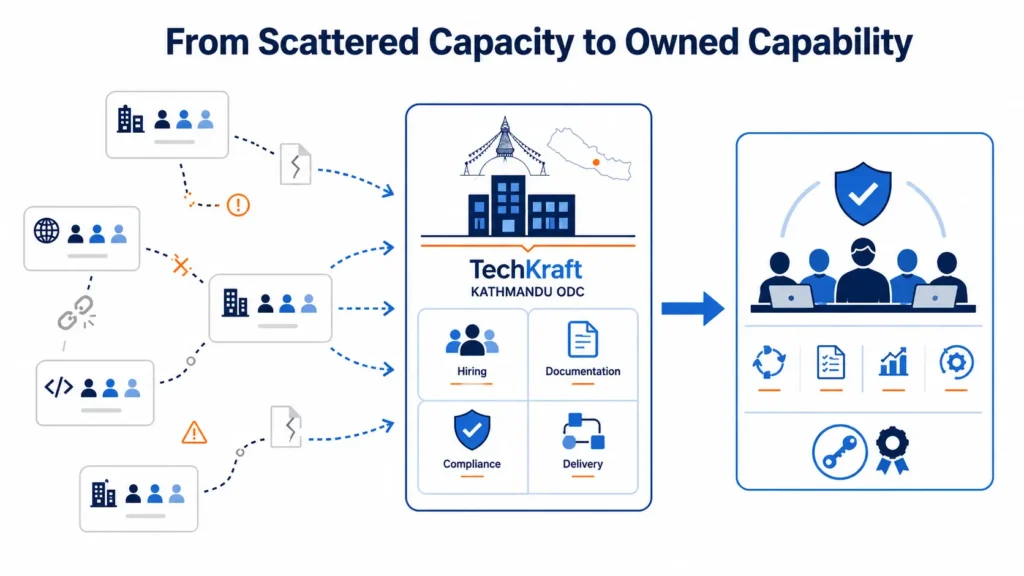
When they engaged TechKraft, they were Series B with over $80 million raised, serving more than 28 million unique members. Their offshore situation was fragmented.
The problems before TechKraft:
- Multiple contractors with no shared goals, communication lags, and no unified delivery accountability
- No centralized documentation, significant context gaps, and redundant work across vendor boundaries
- The US market lacked engineers with the specific combination of healthcare data literacy and engineering depth Abacus needed
- Offshore compliance, legal, and operational risks that Abacus could not manage independently
TechKraft’s approach:
The engagement began with a six-week deep-dive into Abacus’s product and engineering landscape. The team co-developed a roadmap covering platform evolution targets, KPI alignment, and team structure before a single hire was made.
Hiring was executed in three waves, each sequenced by priority:
- Senior engineers and business analysts to stabilize existing workflows and establish documentation standards
- QA, TechOps, and mid-level engineering resources to build depth and process maturity
- SWAT team members, project managers, and documentation specialists to complete the operating system
All team members received domain training covering US payer data structures, CMS compliance rules, HIPAA protocols, and PHI handling before accessing production systems. TechKraft built and fully managed an Offshore Development Center in Kathmandu compliant with HIPAA and ISO 27001 standards. They provided complete business enablement across HR, finance, operations, and infrastructure throughout the engagement.
The results:
- Zero to 85+ FTEs in 24 months, covering data engineering, QA, TechOps, business analysis, project management, and specialized SWAT functions
- 100% SLA adherence throughout the engagement
- 20+ production data workflows delivered and running at scale
- 35% reduction in QA cycle time

The BOT advantage for Abacus Insights
Abacus Insights avoided all upfront investment risk. TechKraft established the ODC, absorbed the infrastructure and setup costs, and managed compliance from day one. Abacus tested and validated their Nepal operation without any long-term financial commitment.
If the engagement had not worked, they could have exited at zero CapEx.
It worked. Now they own it.
How to Evaluate Nepal as Part of a Broader GCC Strategy
Nepal is not the right answer for every offshore strategy. It is the right answer for specific strategic profiles.
Nepal fits your strategy when:
- You are building for BOT transfer, not short-term project delivery. The retention advantage compounds over 24 to 36 months. It does not pay off in 6.
- You prioritize continuity over volume. If you need 300 engineers in 12 months, Nepal is not the answer. If you need 30 to 80 engineers who will still be there when you transfer, Nepal is worth a serious look.
- You are operating in a regulated vertical. Healthcare, fintech, and any domain requiring HIPAA or ISO 27001 compliance can be served from Nepal with the right partner. Abacus Insights is the proof.
- You want geographic resilience alongside an India-anchored footprint. Nepal serves as a low-friction complement, not a replacement.
Nepal may not fit when:
- You need immediate 200-plus FTE scale with specialized niche expertise across dozens of domains. India’s depth is unmatched at that volume.
- Your engineering domain requires talent concentrations that have not yet developed in Kathmandu (certain hardware, embedded systems, or very early AI research roles).
- You are optimizing purely for hourly rate without a transfer intent. If you just need bodies for a fixed-scope project, the full infrastructure of a BOT engagement is more than you need.
| Nepal Fit Profile | Nepal May Not Fit |
|---|---|
| BOT engagement with 24 to 36-month transfer intent | Immediate 200+ FTE scale requirement |
| Regulated vertical requiring HIPAA or ISO 27001 | Highly niche domain with no Kathmandu talent concentration |
| Retention-first strategy for long-horizon capability building | Fixed-scope project without transfer intent |
| India + 1 geographic diversification | Pure cost-per-hour optimization with no governance requirements |
| Mid-market company building toward first owned offshore entity | Fortune 500 needing global delivery scale across 10+ domains |
The Strategic Position
Nepal is not a low-cost alternative to India. It is a high-retention, regulation-ready, BOT-optimized offshore location that belongs in any serious offshore location conversation.
The market is maturing fast. IT exports crossed $1 billion. The engineering graduate pipeline produces 16,000 engineers annually. The sector is growing at 20% year-on-year. The government has built a fiscal framework designed to attract long-term IT business. The infrastructure risk that existed a decade ago is gone.
What sets Nepal apart for a BOT strategy is not the cost. It is the 8% attrition, the 3.5 to 4-year senior engineer tenure, and what that tenure produces: a team that is still there when the transfer happens, that owns the system they built, and that can operate independently from day one of your ownership.
For founders building toward GCC ownership, continuity of the team is the product you are building. The location that gives you that continuity is the location that gives you the most valuable transfer.
The BOT Path to GCC: A Founder’s Guide
Get the complete founder’s playbook on
Build-Operate-Transfer.
Includes:
BOT framework, readiness checklist & case study